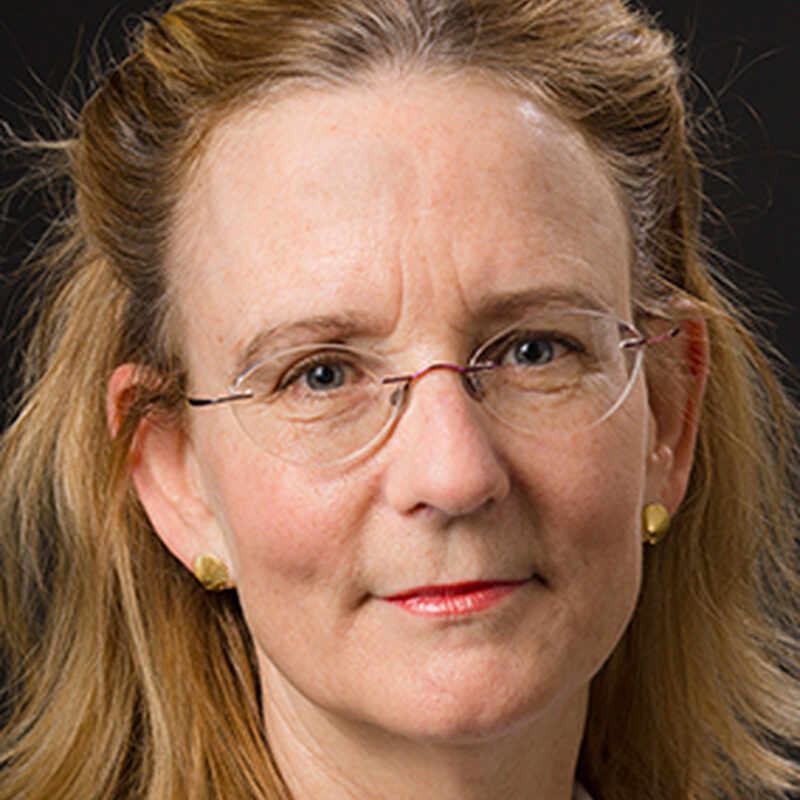
Welcome to TEDMED conversations. I’m Kelly Thomas, the director of scientific content at TEDMED. I’m joined today by Lisa Sanders.
Lisa, please share a little bit about your background and the exciting things that you’ve been working on since we last saw you for your TEDMED talk.
Well, lots has happened since then. After working over twenty years in primary care, I left that position at Yale to become the medical director of a clinic where we see patients who have long COVID, and that’s been extremely exciting.
And, you know, other than that, life goes on. I continue to write my column for The New York Times Magazine, working on a book, of course. And, you know, everything else is the same.
Everything but nothing, sometimes it seems.
So before we talk about the clinic and your career, I’d love to touch base a little bit on the TEDMED talk that was so fascinating, and it was such a pleasure to to see in person. So why is it that despite everything that physicians know about the body and disease that medical diagnoses, especially for rare diseases, just still often remains challenging and and elusive?
Because there’s so much to know in medicine. I really think that the Internet in general has been extremely helpful because it gives us access to things that might not be on the top of our brains. And I think, ultimately, it’s possible that artificial intelligence will help us. But I have to say that I think the most useful tool hasn’t been invented yet, but is imagined in what I consider real artificial intelligence. Like, artificial intelligence as it is now is really, artificial human intelligence.
I think that there’s gonna be a a true artificial intelligence that’s not human where we can do did you ever watch Star Trek? There was a doctor on Star Trek. He had a little machine. He held it over people, and he could look into their bodies and find out what was actually wrong with them. When we have that kind of artificial intelligence, diagnosis will be a piece of cake. But until then, we have to depend on our minds to take us to where we need to go. And our minds are, I’m sorry to say, kinda limited compared to the amount of knowledge that it takes.
So it’s and it’s a process. You can’t you can’t go straight from the most obvious.
You can’t look at a patient and say, you have this very rare thing. It’s an odds based kind of practice. You have to start off what’s most likely, and then you can get to what’s less likely. And that’s gonna be further down the line. So it’s a process. We’re still working on getting better at this process using developing tools for this process, but it’s still a process.
Are there any tools that you’ve come across recently that are helping you that maybe, you know, even a few years ago, you didn’t have access to?
Well, I’m not one of these people that jump on the new thing. I have several friends, not doctors or not internists anyway, who think that chat GPT four is the bee’s knees.
Maybe.
But it’s never really been tested.
You know? I mean, the testing that’s been done is when they get the kind of cases that we give to medical students or residents, you know, to pass their boards or tests that I have to take every ten years to pass my boards. So they’re very carefully scripted cases, and all the important information is right there on the surface.
It’s never really been tested with with actual patients, with actual lots of red herrings and and and stuff that isn’t known or isn’t, isn’t offered immediately.
Let’s see what happens then.
Definitely. Over your career, do you have a case that, that stands out as the most challenging diagnosis that you you went through?
Oh, many. I guess the one that comes to mind immediately is a guy in his fifties who had been completely healthy his entire life, and then he got some sort of upper respiratory infection, something I can’t quite remember, some viral thing.
And he felt fine for a while and then became extremely short of breath and had a very hard time doing his usual activity. I think he was some sort of manual worker. I think he was a con not a construction worker, but maybe a foreman. He did a lot of walking and climbing around things, and he was not able to do it.
And so when I examined him, he had I mean, he came to me with his wife brought a huge stack of medical records. So a lot of the research had been done already. And I had looked through that and seen some of the things that people were thinking. But when I examined him, I could see that in his neck, his veins, his jugular veins were really full and very prominent. And his artery, which is right underneath it, was booming.
And so it looked like, you know, his whole neck was, like, throbbing.
And that made me wonder, you know, what was making his veins so big in his in his neck. And he had constrictive pericarditis.
That is the lining around his heart had gotten stiff and was sticking to the heart. And it was like Tommy Boy, that movie where Chris Farley tries to put on a tiny little sports jacket. It’s like big guy in a little coat.
So this was a big heart in a little jacket, and it was really keeping his heart from filling up with blood or even constricting completely.
Interestingly, that had been shown on an echocardiogram that he got earlier but not recognized.
And so I sent him for another echo.
He went for surgery.
His pericardium was peeled off of his heart, and he was fine.
It was amazing.
Lisa, I’m sure you’re seeing a lot of these complicated cases in the long COVID clinic. What was the turning point or the moment where you decided to to open that clinic?
Actually, I didn’t decide to open it. Yale decided to open it, and I was at a birthday party for a friend.
And I ran into a neighbor who’s a cardiologist, and she was saying that she was seeing a lot of long COVID patients and that they were opening a clinic that didn’t specialize in cardiology or pulmonology or neurology, which is how COVID had been managed previously.
They would just pick whichever symptom was most bothersome and go see that specialist. So they wanted to consolidate that to somebody who was more of a generalist.
As soon as she told me that there was going to be a long COVID clinic, I was interested. I’ve been an internist and a primary care doctor. They’re two different things, actually, for all of my career. And I thought this would be an opportunity to be in on something when it was just beginning, when so little was known. And I thought that would be I I felt very excited by that possibility.
And so I immediately went home and sent an email to the person I thought would know the most about it and eventually just applied for the job and got it.
Congratulations.
And I know you’ve been working so hard there, and you’re seeing patients who have these really broad range of over two hundred symptoms that really affect your entire body. Is there a pattern to what you’re seeing as the most common symptoms at this moment?
I think that the symptoms are fatigue and brain fog and tachycardia, which is often caused by something called postural orthostatic tachycardia syndrome, muscle pains, joint pains, you know, and a few other things, but I would say and sleep interruption.
A lot of these patients have terrible, terrible sleep, which probably contributes to their fatigue. But, you know, about maybe twenty five percent of the patients that I see really have something else going on, and that’s also exciting. I mean, part of my job is to address the things that are caused by long COVID, but the other part of my job is to make sure that there is nothing else going on. And so that balance is really interesting. Lots of things cause fatigue, and you just have to make sure they don’t have any of the other things that cause fatigue.
Absolutely. And these are pretty debilitating symptoms to have that really affect your quality of life, and it can last up to a year. How do you deal with helping them cope with the possibility that you can’t give them something that’s gonna make it go away immediately?
The first thing that I have to do is explain that long COVID is not like a single disease. We’re not even sure what about COVID causes long COVID.
We’re not sure why certain people get it and other people don’t. I can’t tell you how many husband and wife teams come in and they both got it. One has long COVID and the other one is fine.
So we don’t understand any of those things. So first, I make sure that they don’t have anything else. You know? Almost everybody with fatigue gets, you know, the kind of routine blood work if it hasn’t already been done recently to make sure they’re not anemic and that their thyroid is okay and that their kidneys are working and that their liver is working and all the usual things.
A lot of people I send to have sleep studies, and I don’t know if COVID causes people to have sleep apnea.
I suspect that at least some of them have had it for a long time, and then the additional fatigue caused by a postviral syndrome makes them even more tired.
Once we get all the testing done, then we can try to work on what’s left.
For the people who have sleep apnea, hooray.
Here’s something that we can actually treat.
A lot of the other things, we don’t have as good treatment for.
One of the common complaints I hear is exercise intolerance. I can’t exercise the way I used to. And many of those people have POTS, postural orthostatic tachycardia syndrome, where when they they only feel good lying down.
As soon as they sit up and certainly when they stand up, their heart goes nuts, starts to beat rapidly. The way I explain it to myself is that this is kind of a neuropathy where the nerves that tell your blood vessels to squeeze the blood up to your heart are not working. And so, normally, when you or I stand, blood immediately goes from where it’s stored in your abdomen and in your legs up to your heart so that you have enough blood to get all the muscles, the the fuel they need to just do something as simple as stand.
In patients with POTS, as we call it, that doesn’t happen. And so either it takes a long time for the blood to get up to the heart or mostly the heart has to work with a lot less blood.
And, actually, if you look at the echocardiograms of patients who have had this for a long time, their hearts actually shrink because they’re used they’re seeing a lot less blood. There are lots of things we can do for that. You know, the first thing we do is get them to wear compression garments and eat a higher sodium diet so that they have fatter blood vessels so that it’s not as hard to squeeze and there’s more blood available for their heartbeat. You know?
So there are lots of and then there are medicines that help do that as well. So try to identify what known phenomenon they have and treat that. Mostly, they don’t develop new and weird diseases. Mostly, they develop the diseases we see in other people, and that’s why being an internist has been so helpful for me.
I’ve seen a lot of these things before. Mhmm. But it’s also not just COVID that has done this. I mean, there are lots of diseases that have these long tails that have never really been looked at before.
It’s only with COVID that these long standing problems have been taken seriously and really investigated.
With patients that do have POTS or the sleep apnea, once they start a treatment for that, is does it help relieve some of their other symptoms from long COVID?
Well, it depends. You know, certainly, if you have sleep apnea and your sleep is interrupted hundreds of times for, you know, just seconds, most people who have sleep apnea, they don’t even know they’re waking up a million times a night because they’re so tired.
If you’re that tired, it’s obviously gonna affect other things. It’s gonna affect how well your brain works. It’s gonna affect a lot of things. It might affect how you eat food. It might affect your digestive system. So my approach is to take it one thing at a time. Let’s go with the low hanging fruit and see what’s left.
And then many people feel a lot better, and then they come back and we take on whatever is left over. You know, sometimes the brain fog doesn’t get better.
And then we have to come up with a few you know, something to help them with that.
Is there a treatment for brain fog?
Actually, there are several. You know, my first step is to send them to something called cognitive therapy. This is not cognitive behavioral therapy where you talk about the how you get in your own way sort of psychologically.
This actually does two things. First, it gives you some skills to help manage a brain that’s, you know, only hitting on six cylinders.
Then there are exercises that you do that they try to help you reconnect some of those synapses and get better.
If that doesn’t work or if that doesn’t get you back to fully where you were, we have medications that might work. There’s two medications that have been studied, used together that try to approach we don’t know what causes brain fog. I mean, like, is it inflammation?
Maybe. Is it some change in the way your brain works? Many of the people who have brain fog actually have something that’s very similar to ADHD.
Their fog is really an inability to pay attention, to concentrate, to focus. And so one of my colleagues here, doctor Fesharaki Zadeh, came up with a two pronged approach to brain fog. First, something for inflammation, which is a medicine you might have never heard of called n acetylcysteine or NAC.
And he combined it with a medicine that is a non stimulant drug that’s used to treat ADHD called guanfacine.
And using those two has been shown to help people think better. And then there are other medicines that haven’t been as well studied, but are sort of use the same ideas.
Mhmm. But we do have some things.
That’s great to hear. It seems like it’s a web of symptoms interconnected, and I’m sure it takes a whole team of different types of doctors, internists like you and then other specialists.
What does care coordination look like?
Well, first, when patients come to see us, we try to have as much information about how their body’s working as possible.
So people who have respiratory problems, we send them to get full PFTs with our respiratory therapist who’s worked with long COVID patients, you know, for years since long COVID started.
Also, everyone is seen by a physical therapist because virtually everyone, not a hundred percent, but I would say ninety five percent of the people that come to see us are terribly deconditioned because they feel so bad. They can’t even they feel like they can’t exercise. Also, if you look on the Internet, there’s a lot of sites that say don’t exercise no matter what.
So we have them seen by our physical therapist. We also have them seen by our social worker because, first of all, having a terrible chronic illness like this, especially since so many of these people were previously pretty healthy, has a lot of effects on their finances, and they’ll end on their mood. Plus, we know that for sure that people who have had COVID often develop new depression or anxiety, not because they were sick, but because COVID actually does something in their brains to trigger these things. So those three providers see patients before I do, and then I see them.
And then if they need subspecialty care, like, if they have something that’s beyond something that I don’t recognize or or they’ve gone through all the therapies I have available, then I send them to the special many specialists who’ve already seen a lot of long COVID patients. You know, I have a cardiologist who’s been seeing them for the last three years. Actually, it’s the cardiologist who told me about this clinic. There are a couple of pulmonologists, lung doctors who have been seeing these patients, a couple of neurologists, and then, you know, endocrinologists. I mean, we I have all of Yale to reach out to to help me with these patients, and it’s really been a very collaborative, and exciting practice to be in right now.
Absolutely. Is there collaboration also between your long COVID clinic and medical research scientists who are investigating biomarkers that can help with the diagnosis of different symptoms of long COVID?
Certainly, I work with the people who are here at Yale who are working. There there are two specialists who are leading groups that are looking into different aspects of, long COVID. So and I’m open to more. I’m starting a blog that will start in December.
And as part of that blog, we’ll have research studies as we see them come up, as they we see them start so that people who come to look for our help can see places closer to them. We get you know, people reach out to us from all over the country. And, of course, it doesn’t make any sense for people to come to New Haven to get care if there’s care that can be obtained closer to home. But we try to facilitate them getting connected to care, and then we try to facilitate them finding out about other studies that are being done. What my blog is gonna focus on is what’s new in long COVID, and hopefully, they’ll be able to stay updated that way.
That’ll be incredibly helpful. How many clinics are there across the country?
We have a list of, you know, a couple of hundred, but a lot of those have closed down because people are so over COVID. COVID is not over us, but we are over COVID. And so people have feel like it’s not needed anymore. And I couldn’t disagree more. It’s not just COVID that causes these post infectious syndromes.
You know, we know that Lyme disease can cause this kind of post infectious disorder.
Mono causes this long thing. And there are a whole bunch of other diseases. You know? I know of, you know, twenty or thirty that have this even the flu can have this long tail.
And there are a lot of people who go to their doctor and their doctor go, that was ages ago that you had the flu or mono. You should be better by now, but they’re not. And I think that a clinic that is focused on these long tails of infections is totally necessary.
We’ll see if if they survive.
Do you think that that concept, not just looking at the long tail of long COVID, but other diseases becoming, you know, more mainstream?
Yeah. And in fact, you know, Mount Sinai in New York City was one of the first long COVID clinics. They became a long COVID clinic the same way everybody got involved in long COVID. They took care of patients with COVID, and they didn’t get better.
And so at Mount Sinai, they, just a few months ago, changed the way they present themselves from being a long COVID clinic to being a postinfectious syndrome clinic. And I think I mean, that’s just the one I know about off the top of my head. I’m sure that other clinics are going to do the same thing because this is fascinating stuff. This is how our immune system is working.
It’s such an insight into an area about which we know very little and yet which affects, you know, tens of thousands, hundreds of thousands, maybe millions of people. We don’t even know. There are lots of things that we’ve known about for a long time that turn out to probably be postinfectious syndromes, like chronic fatigue syndrome, which is, you know, now known as myalgic encephalopathy chronic fatigue syndrome, because I think people thought that chronic fatigue syndrome wasn’t being taken seriously enough. So there are a lot of illnesses that we now recognize to be part of this post infectious syndrome series of symptoms.
So I hope that we can move out from just COVID to all the illnesses that cause these kinds of symptoms.
This sounds like the start of a new specialty to me, Lisa.
Maybe a a future specialty that, you can pioneer at Yale.
We are, though, seeing a lot of new research papers coming out, really trying to dive into specific biomarkers or developments of blood tests. And do you think that’s possible and that can help the process for long COVID and maybe other, post infectious syndromes as well?
So, I mean, there have been a lot of candidates put out there, things that, oh, look. We see this in people who have long COVID. And then they find out, oh, they’re actually in people who don’t have long COVID, which makes them a lot less useful. But I think that it’s inevitable that we’ll figure out some footprint for this disorder. You know, I mean, there are already things that have been seen in patients who have long COVID. For example, a lot of patients who have long COVID have low cortisone, sort of one of the fight or flight hormones made by your adrenal glands.
But there are lots of things that cause low cortisol. So that’s not gonna be that’s not gonna be enough. But I think people will come up with markers with tests that can help us identify this.
Anyway, that’s my hope. And I think it seems very likely because there are a lot of smart people trying it, working on it. Mhmm. And that’s a good sign.
Absolutely.
Lisa, you are definitely a natural storyteller. And if long COVID has a story, what do you think the next chapter is?
I think that what we’ve been talking about is the next chapter of long COVID, that we’re gonna see the relationship.
First of all, that we’re gonna see we’re gonna figure out how this all works, you know, how an infection can change our bodies so these symptoms continue long after all the bugs are gone.
And I also think that we’re going to expand beyond COVID to all the other illnesses that can cause these long post infectious syndromes. So that’s what I see as the next chapter. First, we’re gonna have a better grip on long COVID, and then we’re going to spread our interest to all the other causes of postinfectious syndromes.
I look forward to seeing this unfold, and, we at TEDMED are incredibly grateful for the very important work you’re doing at Yale and elsewhere.
Thanks.
Welcome. So I would like to talk about your very intriguing background. It’s multifaceted.
You have always been a detective by nature, first as a journalist, now also as a physician.
What happened that led you to pursue medical school after you had already, established yourself as a journalist?
I saw something that changed my sense of the possibilities of the world. I was working with a a doctor, medical correspondent named Bob Arnott, on a show called forty eight hours on crack street.
It was a long time ago. And we were standing we were at Metropolitan Hospital in the Bronx in New York City. And it was three o’clock in the morning, and we were standing outside getting some air. We were in the ED just seeing what came in because that was the beginning of the crack epidemic, and a lot of patients were coming in with problems from smoking crack. So we were just standing outside, and this guy walked up to us, ran up to us really and said, are you a doctor?
And I looked at Bob and he goes, yeah. I’m a doctor. He goes, my friend was having chest pain, and we were coming to the hospital, and he suddenly collapsed. And he’s I can’t get him up, and he’s lying in the grass over here.
So we ran off after him, and there was this guy, and Bob put his fingers on his carotid artery.
Nothing.
And so he looked at me and he said, I’m not licensed to practice medicine anymore.
And then he took both hands and thumped this guy on the chest really hard.
And almost immediately, he gasped for breath and opened his eyes.
I now know that he was probably in ventricular fibrillation and that a kind of sharp blow to the chest can shock the heart out of that. I didn’t know it at the time, but this guy who was dead came back to life.
And it occurred to me that I was never going to be able to save a life like that.
I didn’t I didn’t and, actually, up until that moment, I didn’t even know that was something that I cared about. I mean, it’s not like I didn’t know there were doctors. It’s just that I’d never thought about that with respect to what I could do.
And it just planted it in my mind, and it percolated there for a long time. It took me about another five or six years to think, oh, maybe I should go to medical school.
But it finally dawned on me. It sort of finally took roost in my brain in a meaningful way, and I thought maybe I should go to medical school. Maybe I should try to save people’s lives.
And it was a great decision. I’ve enjoyed every step of the way.
That’s an amazing story and an incredible transition. If you could have gone back in time and advised your younger self, would you have said something that would have caused you to realize that earlier in life?
No. Absolutely not. You know, the practice of medicine is something that is filled with uncertainty, and I could have never managed that uncertainty straight out of college. I just couldn’t have done it.
And it’s not just me. I mean, I think a lot of people who go straight through high school, college, medical school, residency, the real world, they also have trouble dealing with uncertainty. And so what you see is people going into teeny subspecialties where they feel like they can master everything that is known about something and never have to deal with uncertainty. Of course, that’s a false goal.
I mean, there’s always uncertainty between the complexity of the body and the limitation of what we know now. There’s always gonna be a lot of uncertainty, but it would not have felt comfortable to me right out of college. I really appreciated what I learned in my careers after college and before medical school. I think they helped me prepare for the doctor I wanted to be.
Lisa, you have an incredible love of writing, and you are working with the Yale internal medical residency writer’s workshop program. What prompted you to to join that program?
Well, you know, when I became a doctor, I recognized that the tools that journalists use and really the access to people’s private stories that journalists have is what doctors have.
We use a lot of the same tools. And for a diagnosis to make sense, it has to sort of make stories sense in a in a strange way. The same way when you read a story and you feel like, oh, that didn’t work at all. That doesn’t make any sense at all. That same sort of critical power comes into play when you’re making a diagnosis. And so to me, it seemed obvious or inevitable that doctors should be storytellers, should be writers. A lot of doctors come to medical school with maybe they wrote when they were in high school, maybe not, but with an interest in storytelling.
I mean, I think that’s one of the chief motivators for people to be interested in medicine as opposed to science. I mean, all of these things tell stories, but the kind of human stories that doctors tell, I think, draws a lot of people who might also be interested in telling stories in a different way. And so to me, the writer’s workshop is an opportunity to help people do that well.
I think we have a lot of stories to tell. So many of the most important issues that we look at as a country, as as a species, have to do with medicine. And I think that we doctors should be the experts. But in order to be the experts, we have to be able to get out there and and speak and tell these stories and write these stories. So to me, that was a very exciting opportunity. And I got to work with some great writers and, you know, and I feel like the world is now filled with writers that have passed through the Yale, Writers’ Workshop and are out writing and publishing and telling stories.
And that’s a great feeling.
That must feel incredibly rewarding.
And you’ve brought together so many meaningful experiences from your career as a physician and a journalist, and you continue to do great work.
And I’m curious to know what is next.
You know, I think my next goal is to get other doctors excited about this aspect of medicine, this postinfectious syndrome. I think that it hasn’t gotten the respect or the appreciation it really deserves. When I first said I was gonna go do this, there was a lot of, really? And to be fair, a lot of these patients who have complicated syndromes or symptoms and lots of them, they don’t fit naturally into a primary care doctor’s schedule. You know, if you’re a primary care doctor and you have fifteen or twenty minutes to see a patient, when somebody comes in and tells you that they’re dizzy or their heart beats too fast or they’re tired all the time, you know, or all of the above, something in you can’t help but look at your watch and think, can I how much can I get done in the time I have available?
And so these patients make doctors frustrated in part because it shows up what’s wrong with our system. We have a system that has no wiggle room in it. We have no ability to make room for patients who are complicated.
So we just send them to subspecialists.
I think that this kind of marriage of complicated patients and people with broad knowledge like internists is an obvious match, but we need the space to do it in. So I wanna bring people into my clinic, show them how it works, and get them excited about these possibilities.
And I hope that just as we have these writers that go off and write, I wanna have internists who go off and start these clinics themselves because I think that there’s a need for it. And I think that it will save money, improve lives, and keep doctors interested. You know?
We’ve all been to the doctor who you think is not the least bit interested in your symptoms.
Somebody who sees something different every day like I do, that will never happen.
So so my next goal is to generate the next generation of people who do this kind of work.
I think that’s a very ambitious and important, goal to have, and I look forward to seeing where you take this new journey. Thank you so much for sitting down with TEDMED today to have this conversation. We appreciate it.
Well, thanks so much for inviting me. This has really been a great conversation. Thank you.