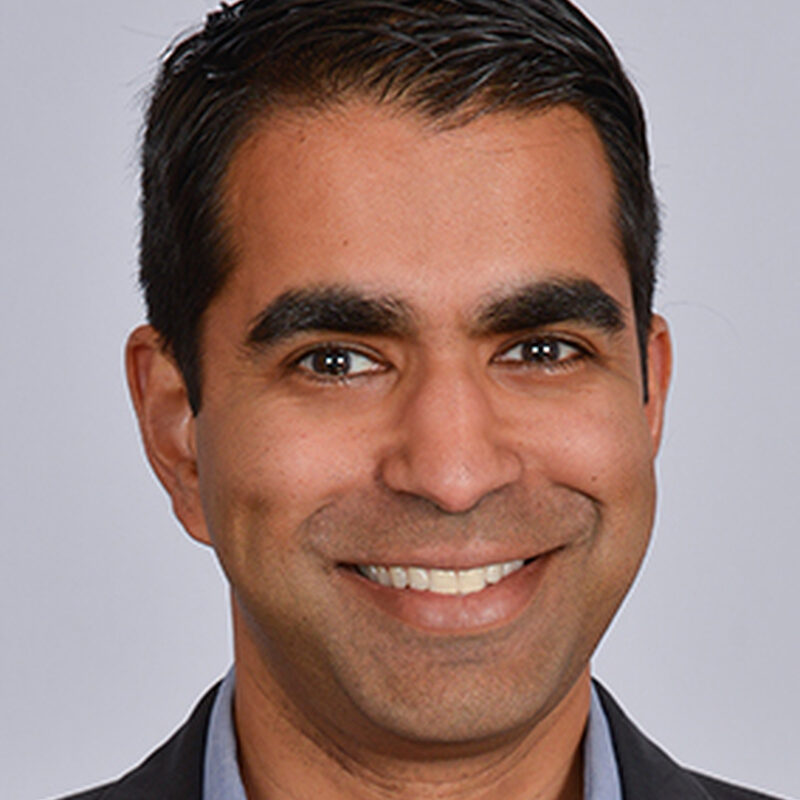
Hello. I’m Kelly Thomas. I am the director of scientific content at TEDMED, and I am joined today by Baku Jenna. Babu, please, share a bit about your background and the exciting things you’ve been working on since we last saw you for your TEDMED talk a few years ago.
Yes. It’s been a long time. My name is Babu Jena. I’m an economist and a physician.
I’m a professor at Harvard Medical School, and I see patients at Massachusetts General Hospital.
And I host a podcast called Freakonomics MD and wrote a book with Christopher Worsham called Random Acts of Medicine.
I’d like to talk about AI, which has been all over the news, and there’s just a kind of a flurry of excitement around it and caution, hope. What do you see as the promise of AI as it applies to health care and and making positive or negative impact?
First of all, Kelly, you’re not even really talking to me right now. You’re talking to an artificial intelligence generated version of me. That’s why it sounds so much better.
I think there’s a I think there’s a lot of promise. I I kind of would separate the role of AI in medicine into a few different categories.
So one is what I would think of as more of a a surveillance system, where AI allows medical providers to make decisions that they would make if they were fully informed if there were not all sorts of other things that were drawing on their attention. What do I mean by that? So one example is someone who comes into the emergency department with chest pain.
And, you know, we know chest pain might be indicative of a heart attack, but there are certain pieces of information that we know to look for that we might miss. So for example, there might be certain features of an EKG, the the measurement of electrical activity in the heart. There are certain features of the EKG that we might know this suggests this person is having a heart attack. But if the doctor or the nurse or whoever else is seeing the patient is busy or distracted or maybe even fails to get the EKG, then in those situations, they may miss a diagnosis that they otherwise would have been perfectly capable of knowing in sort of a full information setting. So in places like that, I think AI can be working in the background to try to identify those sorts of misdiagnoses.
And these sorts of things happen all over the place in medicine. I’m speaking about heart attacks here, but it could be a pattern of information in the electronic health record that indicates this person has cancer or pneumonia or other medical problems. So that’s one use case, and I think that’s where most of the effort has been focused so far, and it’s certainly a place to improve how we deliver care. The second place is to me personally much more interesting because it it suggests a new way of understanding things that we have been previously unable to understand.
What do I mean by that? So I’ll I’ll maybe I’ll go back to the chest pain example. So there are features in the EKG of someone who’s having chest pain that we know indicate that this person might be having a heart attack. The EKG is essentially a series of electrical waveforms that show up on a computer screen or a piece of paper, and there’s certain waveforms, certain shapes that indicate that this person might be having a heart attack.
And we know that because over decades, we have seen people or, you know, doctors and researchers have seen people who have heart attacks and people who don’t and have sort of uncovered almost by brute force method what are the sorts of patterns that we see on the EKG in people who have a heart attack. And we now teach people that, we teach doctors that, medical students that, cardiologists that, machines learn that, and that’s how we diagnose heart attacks. But it could also be the case that there are people who have heart attacks for whom there are features, there are signals in that EKG that we don’t yet know are indicative of a heart attack.
And that’s just because the way that the waveforms manifest on the EKG might be much more subtle than a, you know, huge, what we call, tombstone on the EKG, something that’s clearly apparent to the human eye.
These are things that may not be immediately apparent, maybe more subtle signatures.
And there with artificial intelligence, you do have the ability to look at many, many people who have a heart attack and many, many people who do not have a heart attack and then ask the system, the computer to figure out what are the features of the EKG that suggest someone is having a heart attack versus not. And that predictive exercise is important for two reasons.
One, I think it’s important because it can help us better predict who’s having a heart attack and who’s not. So we don’t make that diagnostic error. We don’t miss a diagnosis.
But the other thing is it would teach us, look, here are these features in the EKG that you’ve never been looking for, but now you should be looking for. So it adds some sort of scientific knowledge as well. It helps us understand what is it about the EKG that’s allowing us to figure out whether someone is having a heart attack versus not. So I I think of this as it’s really sophisticated pattern recognition, but I think it’s it’s still a a a different use case than one where we say we already know how to diagnose a problem. We just sometimes make mistakes when we’re doing it. So those are sort of the two use cases I see for AI. And I think there’s a lot of promise in both, but I’m particularly interested in the latter.
I wanna end with a question. Why do you have hope that natural experiments can help us, you know, get on a path towards improving health care and medicine over the long term?
So I think there’s a, you know, there’s a huge amount of interest in, in medicine about using what we call real world data to try to understand what works and doesn’t work. So as I alluded to earlier, the way that drugs are used typically is we we have a randomized trial. That information tells us something about the cause and effect relationship of the drug. What is the what is the effect of the drug on some outcome that we care about?
And the Food and Drug Administration and other regulatory agencies across the world use that kind of information. But still, it’s hard to conduct randomized controlled trials over every single disease setting, over every single drug. And so we’re kinda left with figuring out what’s the next best solution. And and one thing that people try to do is use real world data to try to answer that question.
And the fundamental problem there is that you can’t look at people who receive one drug versus another in the real world and argue that any differences in outcomes between those two groups of people are due to the drug. It’s not it’s not that because there’s all sorts of other reasons why people might take the drug. And if those things are correlated with the effects or the outcomes that we observe, then we can’t really say this is the effect of the drug. It might be something else that we’re picking up.
It’s sort of this phrase that you will sometimes hear, correlation is not causation. Right? And that’s that’s the underlying problem. Natural experiments, I think, are a really powerful way to sidestep that issue because they they rely on this idea that sometimes nature affords us this experiment where people might, by chance, be exposed to one medication versus another to allow us to figure out what the causal effect of being on that drug is.
Mhmm. It could be, for example, Kelly, that you go to the emergency department and you happen to see a doctor who’s who tends to prescribe drug a. And if you went to the ED on the next day, you’d see a different doctor who tends to prescribe drug b. Now that’s a natural experiment because now you have a group of people who are prescribed drug a and a group of people who are prescribed drug b almost by chance, simply by a function of what day they happen to go to the ED in which doctor they happen to see.
Or you look at people who are hospitalized during a period of a short term drug shortage.
Those things happen quite a bit. And if you’re a patient, you don’t go to the hospital or decide not to go to the hospital based on a drug shortage nationally that you may not even know about. Alright? But you go to the hospital, and that drug that you would otherwise have received happens not to be available. Well, what’s the impact of that on you? Are you worse off clinically, or is there no effect?
That sort of natural experiment could help us figure out whether one drug works versus another. And so I think that’s the take home for me is that these are powerful experiments to be able to figure out what works and what doesn’t work in medicine.
Absolutely. I I completely agree, and I’m so glad that you’re exploring these types of experiments and and, teaching everyone else to think about them as well. And I really appreciate you sitting down with TEDMED today, and we hope to speak to you again.
Thank you.