Welcome to TEDMED NOW, where science and story inspire curiosity. I’m your host, Kelly Thomas.
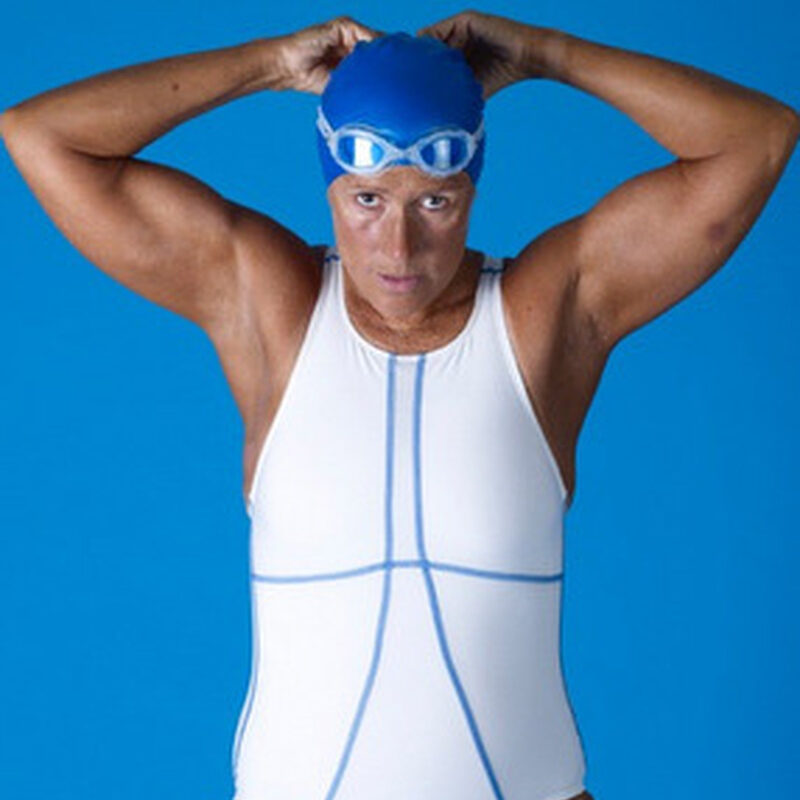
There is a power in stories of endurance, the kind that feel mythic. Few capture that truth more vividly than swimmer Diana Nyad, who spent decades chasing one dream.
To swim from Cuba to Florida, one hundred and ten miles through shark filled waters, violent currents, pitch black nights, and jellyfish whose sting can stop a heart.
Her journey wasn’t just across the ocean. It was across the boundaries of age, fear, and doubt.
From a five year old who was told her name meant champion swimmer to a sixty four year old who finally touched the sands of Key West on her fifth attempt.
Her story is about grit. Yes.
But also about something quieter. How failure, when faced with courage, reshapes the brain.
Today on TEDMED NOW, we follow Diana’s ocean and then dive into the neuroscience of resilience.
Because science tells us something powerful. Failure isn’t a verdict, it’s feedback, raw data the brain uses to grow. Sometimes resilience isn’t bouncing back, It’s finding a way forward even when the tide pulls hard against you.
Let’s begin with Diana’s story.
The day I turned five, my father was very dramatic and larger than life. Every every day was an exaltation for Aristotle Zenith Naiad.
And he had Webster’s on a bridge dictionary open on the office desk, and he called me in. And he said, darling, I am so excited for this day because today you are going to understand the most important thing I will ever tell you. Come here, darling. Your name, my name is in the dictionary.
That’s alright. It says, NIAID, girl or woman, champion swimmer. Oh my god. This is your destiny darling.
Well, now I was only five, so I didn’t take in the destiny part and frankly never have. But I became a little swimmer. And I was swimming six hours a day, getting up at four thirty every morning, holidays included. I was doing a thousand sit ups every day, never ever nine hundred ninety nine.
Those early mornings didn’t just build a swimmer’s body, They built a swimmer’s brain.
Because resilience isn’t just a personality trait. At the cellular level, it’s plasticity. The brain’s ability to rewire itself in response to challenge and repetition.
Every stroke, every failure, every return to the pool was triggering microscopic change.
Neurons fired together more often, strengthening their synapses, building faster, more efficient communication pathways.
New dendritic branches sprouted, increasing the brain’s connectivity. Proteins like brain derived neurotrophic factor and hormones like insulin like growth factor rose, acting as biological fertilizer, encouraging synapse formation, gene expression, and long term neural adaptation.
BDNF strengthens connections called synapses in the brain, supports learning and memory, and promotes the formation of new neurons.
IGF-one plays an important role in growth, repair, and cellular survival throughout the body, including the nervous system.
In essence, the brain wasn’t just learning endurance. It was being rebuilt for it.
Endurance training is one of the most powerful drivers of neuroplasticity we know. The harder the effort, the deeper the imprint.
So long before Diana faced open oceans, storms, and sharks, her brain had already been shaped for persistence. She had been training for adversity at the molecular level, building a nervous system capable of grit.
And she would need every bit of that biological resilience because the Cuba to Florida swim isn’t just long, it’s alive.
A gulf stream that pushes you sideways, winds that turn the ocean into mountains, a night sky so dark it erases the horizon, deadly creatures lurking below.
So I became this ocean swimmer, and I had achieved some notoriety in my twenties, but always that little vision was rattling around somewhere in my imagination. And as I started to research it, I found out that it wasn’t just me. Many strong swimmers had tried the crossing since nineteen fifty. It’s kind of the Mount Everest of the oceans.
It is the vast, epic wilderness of our sport. Not only is the distance undeniable, but the Gulf Stream comes raging out of the Yucatan channel and is flowing hard to the east. And as it’s flowing to the east at four to five times a swimmer’s speed, you are trying to try to make it due north. And every little bit of easting and not northing means that you are never going to reach land.
Despite knowing all this, Nayad tried five times to swim one hundred and ten miles from Cuba to Florida.
What gives someone that kind of mental strength?
What in the brain allows a person to face failure and keep moving forward?
Neuroscience offers a compelling answer.
When we confront failure or unexpected outcomes and decide to try again, the brain doesn’t shut down.
Instead, it activates core circuits involved in reward, learning and adaptation.
Especially in the ventral striatum, which is part of the basal ganglia reward system and regions of the prefrontal cortex.
This activation reflects processing of reward prediction error, the difference between what we expect and what actually happens.
RPEs are fundamental to learning.
They signal this didn’t go as planned, adjust, try again.
Human neuroimaging studies show that greater RPE related activity in the ventral striatum predicts improved memory, learning and behavior adjustment.
Each attempt, each failure, each decision to persist strengthens neural pathways for focus, motivation, and behavioral adaptation.
Over time, the brain literally becomes better wired to cope under stress, persist through discomfort, and learn from setbacks.
That’s part of what long distance runners describe as hitting the wall. But biologically, it’s a shift.
The brain moves from relying on short term, fast circuits to deeper, more durable networks built for endurance, adaptation, and resilience.
And that’s exactly what Diana did.
I turned sixty, and I just was choked with a kind of a life angst.
Was I the person I could admire?
It wasn’t about sport and records and hall of fame for me anymore.
My mom had just died at eighty two.
I wanted to feel some unwavering commitment again. I wanted to feel alive.
I wanted to tap every ounce of potential in me and surround myself with people who felt the same sort of high.
And it was all about Cuba. Cuba represented to me living life large, and I went to chase that dream because it’s never too late to chase our dreams.
And I failed, and I failed again, and I failed again. And after the fourth time, this event was stamped impossible.
The sports scientists, sports nutritionists, the historians, the marathon swimmers, all came to me with their empirical data. You can’t be swimming in the supine position and take in nutrition for that long a time immersed in salt water.
Even my team, they were still with me, but at every meeting, somebody in the back would say, Diana, have you looked at Guam this time of year? It’s just lovely. But I had faith.
She failed again and again, and each failure could have been the end.
Instead, she treated failure as information.
Each setback became data, each attempt a new neural lesson.
After four failures and decades of training, she tried a fifth time and made it.
Fifty three hours in the water, jellyfish stings, hallucinations, a team refusing to let her quit.
So what happens in a brain that just refuses to quit?
Every time we fail and try again, something remarkable happens.
The brain changes.
It starts building new connections, linking effort with reward.
Over time, those pathways strengthen. That’s how persistence literally reshapes motivation itself.
Neuroscience gives us evidence for exactly this kind of transformation.
Studies show that physical effort or sustained challenge, like the grueling training faced by a swimmer, triggers increases in neurotrophins like BDNF. BDNF encourages synapt formation, dendritic growth and enhanced connectivity.
Exercise driven neuroplasticity isn’t just theoretical. Research shows that aerobic training improves not only cognitive function, but structural and functional brain resilience, expanding gray matter volume in prefrontal areas, enhancing blood flow, and supporting networks linked to memory, focus, and emotional regulation.
Resilience then isn’t just about bouncing back.
It’s more like a full biological rewiring.
A transformation born from repetition, feedback, and physical exertion.
When we push through setbacks, the brain responds not only with stress hormones, but by strengthening neural circuits between higher order control centers like the prefrontal cortex and emotion or reward related centers.
Over time, recovery from adversity becomes easier. The brain learns, I can survive this. I can adapt.
And the more we practice that, in sport, in work, in life, the more automatic it becomes.
Neural growth factors arise, structural changes accumulate, connectivity improves.
The brain gets better at resilience the same way muscles get stronger, through challenge, recovery, and adaptation.
That’s where resilience lives, between data and faith, between biological evidence that says you are adapting and the quiet stubborn belief that says keep going.
Because that’s the space where every logical reason to quit meets the will to continue.
And when you stay there long enough, when you keep showing up despite the odds, that’s when the rewiring happens.
And the one thing that all this science wasn’t producing was the power of the human spirit.
So, there we went and we stood on the Havana shore one more time at Marina Hemingway. And Bonnie, my head handler, grabbed my shoulders and she said, let’s find a way.
Not let’s try again. Not let’s hope for the best, but let’s find a way.
It’s the most practical form of resilience when optimism becomes problem solving and persistence becomes partnership.
Bonnie calls me over and she says, come here, come here, you need to know this.
Take a look over there toward the horizon. You see that little white filament? And I said, put my goggles on my forehead, and I said, oh my god, the sun’s coming up. I can get the jellyfish gear off again soon, and the sun’s going to warm me up. And she said, it’s better than the sun. Those are the lights of Key West.
I waited thirty five years for that vision to come true.
And, you know, walking up on that shore, and it’s still the same today, true, a year later, is that I I didn’t feel some big ego rush like I did this. First of all, make no mistake, we did this. I had a team, and they were dedicated, and they were proof positive that perseverance and the soul of friendship can get anything done. We walked up onto that beach.
That rewiring, that dance between data and faith defines Diana Nyad’s story.
Think about it. For more than thirty years, she chased one dream, to swim from Cuba to Florida without a shark cage.
She failed again and again, stung by jellyfish, thrown off course by storms, forced to climb out of the water just miles before the shore.
But every failure was also training, not just for her body, but for her brain.
Each setback strengthened the circuits that link effort to reward, that teach us how to keep going even when the outcome looks impossible.
When she finally made it, at age sixty four, after nearly fifty three hours in the water, That victory wasn’t just muscle or endurance.
It was the culmination of thousands of moments of persistence.
Each one had left a trace in her brain, a biological record of resilience.
Because by then, her brain, not just her body, had been training for her entire life.
But what she says next might be the most profound lesson of all.
I’m living proof, and my team is living proof that whether it’s your profession and you’re up against it and the innovations that you want so badly to to push through or being stymied in some way in your personal relationships and your health, if you want to reach that other shore of yours, you will find a way.
That’s the truth of resilience. It’s not a solo act. It’s a shared triumph.
It’s who we become through the people who refuse to let us quit.
Strong social bonds strengthen the brain’s resilience circuits, making us better at weathering adversity.
We are wired to persevere together.
I don’t know if you’re familiar with the Henry David Thoreau quote, but this past year, it has rung true for me so profoundly.
And it goes something like, when you achieve your dreams, it’s not so much what you get, it’s who you become.
How proud am I to stand in front of you and say to you that I’m a person who never ever gives up?
As we consider what will build, what will change, and who will become, let Diana’s story remind us.
Resilience isn’t reserved for elite athletes or adventurers.
It lives in all of us, in the small daily choices to keep going, to find a way to never ever give up.
Thank you for listening to TEDMED now. Join us next time as we continue exploring how science and story shape our understanding of resilience and of ourselves.