Science in the Public Square
What happens to science once it leaves the lab?
Not as a body of knowledge, but as something that moves through institutions, markets, and public discourse, where evidence is filtered, shaped, and sometimes contested.
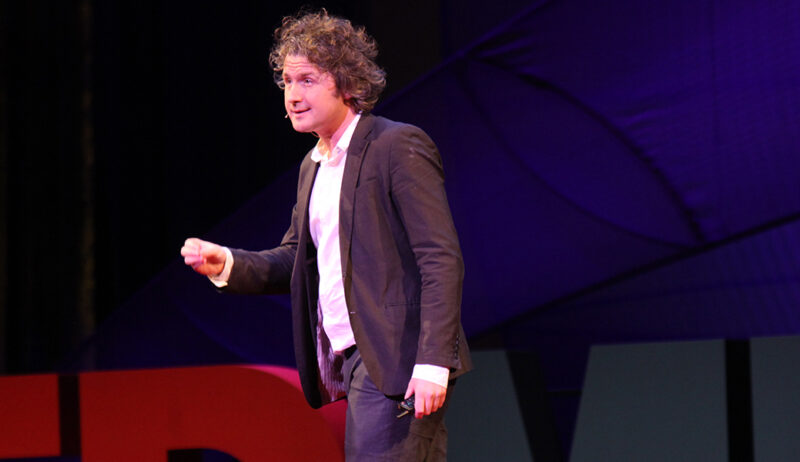
Ben Goldacre begins with the foundation: the evidence itself. When data is incomplete or selectively reported, what we call “truth” is already unstable. Dorothy Roberts shows how scientific frameworks can carry social assumptions, revealing how race-based medicine reflects not just biology, but bias embedded in the system. Elizabeth Marincola examines what happens when science intersects with money and access, where transparency becomes a point of tension rather than a guarantee.
As science moves outward, interpretation becomes just as critical as discovery. Francis Shen explores how neuroscience is translated into narrative, shaping how ideas about the brain are understood and applied. Leana Wen brings that translation into the clinical encounter, where what is said, and what is withheld, directly affects patient decisions. And Katherine Eban exposes how global systems of production and oversight can quietly compromise the integrity of medicine itself.
Across these perspectives, a pattern emerges: scientific truth is not only discovered, it is mediated. It is shaped by who controls information, how it is communicated, and where power sits in the system.
Together, these Talks trace the path of science as it enters public life, showing how evidence becomes action, and how trust is built, challenged, or lost along the way.
Explore where science meets power, and what happens when truth is no longer self-contained.
Where’s the rest of the data iceberg?
Ben Goldacre
What we don’t know can hurt us: Industry bias against negative outcomes means vast amounts of research goes unpublished, Ben Goldacre says.
More About This TalkAbout Ben Goldacre
An award-winning writer and broadcaster, Ben Goldacre was trained in medicine at Oxford and London and now works full time as a physician. Since 2003, he has written the weekly Bad Science column in The Guardian, where he debunks any and all unfounded scientific claims made by parties from government to journalists and pharmaceutical companies. His book Bad Science (4th Estate), published in 25 countries, has sold over 500,000 copies worldwide, topping the paperback non-fiction charts. Among Goldacre’s many awards are the Royal Statistical Society’s first Award For Statistical Excellence in Journalism, the Faculty of Public Health DARE Prize Lecture, an honorary doctorate from Herriott-Watt University, “Best Freelancer” at the Medical Journalists Awards 2006, the Healthwatch Award in 2006, and “Best Feature” at the British Science Writers Awards (twice). He was also shortlisted in the Samuel Johnson and Royal Society literary prizes in 2009. Goldacre is a frequent guest on numerous British television and radio programs and speaks regularly at conferences and events. He made The Rise of the Lifestyle Nutritionists, as well as the two-part documentary The Placebo Effect, for BBC Radio 4. He is currently producing a three-part documentary series for the BBC World Service.