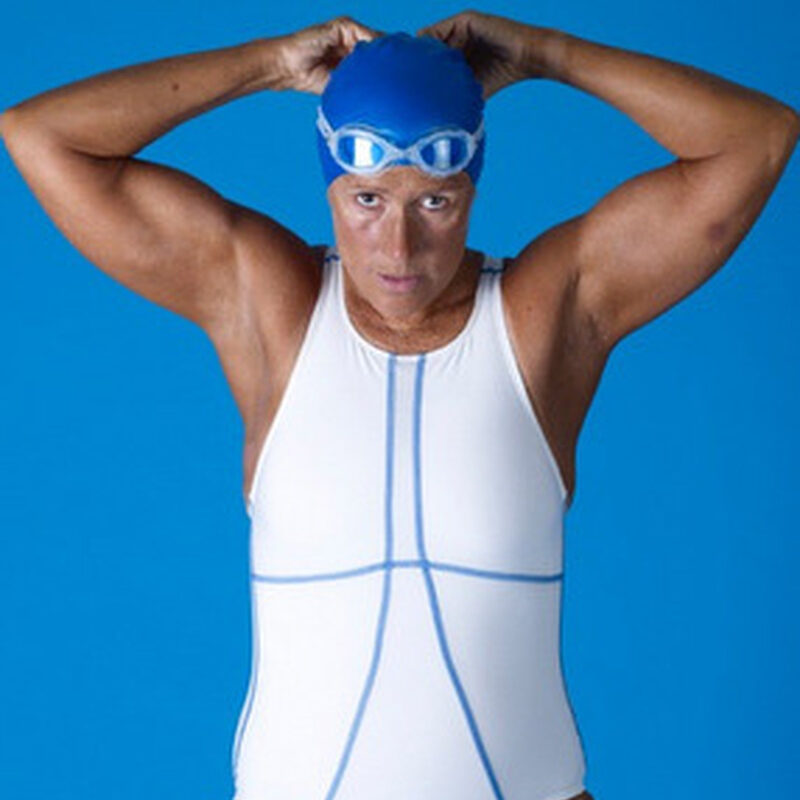
Welcome to TEDMED conversations, where medicine, science, and the human experience meet the ideas shaping our future. In twenty fourteen, Diana Nayad returned to the TEDMED stage, this time having completed the feat she once declared she would achieve, the one hundred ten mile swim from Cuba to Florida.
At age sixty four, after four failed attempts and more than thirty years since her first try, she completed the crossing. Battling the gulf stream and venomous box jellyfish, she finished what once seemed unreachable.
Her talk, no shortcuts to victory, is not a story about toughness alone. It is about preparation, persistence, and the decision to return to a dream long after most people would have let it go.
Hosted by Kelly Thomas, TEDMED’s director of scientific content, Diana dives beneath the headline. What does resilience actually require, and what separates bravado from readiness?
This is a conversation about endurance, not just in the body, but in judgment, about failure that refines rather than defeats, and about what it truly means to go onward.
This is TEDMED Conversations.
Welcome, Diane and Nayad.
Thank you so much for taking time to talk to us today about your journey and what we can learn about the power of the human spirit and resilience and all the incredible experiences and challenges you’ve overcome that teach us such lifelong inspiring lessons. Appreciate you being here.
Thank you. No. It’s it’s my pleasure. And and you know what, Kelly? Before we even get started, I don’t know if you’re aware of this, but I was part of a study, you know, sometime in the last ten years, which was done by both Harvard and University of San Diego together.
And their idea was to see if all human beings or if it’s more people who are Navy SEALs, you know, or people who are trained to dig down and, and face fear without without it overcoming them. But as you went through the test, you’re in this chamber and you’re looking at images, very easy test, and they start restricting your oxygen when you don’t know it. So occasionally, from the outside, they squeeze on your tube. You can look it up, but, I beat all those, Navy Seals and and all those, you know, army rangers.
I was at the top at the end. And I said, what does this really prove? Does this prove that I should be underwater setting grenades? You know?
I don’t know if it proved much, but I thought I’d tell you if you wanna look up that study, it’s out there somewhere.
I did not know about that study, but I think that’s really interesting. And maybe you were a Buddhist monk in a prior life because they’re so good at staying calm.
I would imagine that that has something to do with all the training you did to swim from Cuba to Florida and all the other long distance training that you did because I was a swimmer growing up, nothing as serious as you are, but you have to control your breathing in high stress situations. What did that feel like when you were in the water and you started? Were there any moments where you panicked and you had to rely on that slow breathing? Because I’m sure that helps you in that study if those instances occurred.
The only true moment of panic, I well, I I had two actually, but the most recent one of recent years was being stung by that swarm of box jellyfish. They take your spinal cord and paralyze it. It’s the most potent venom of any animal on earth. There’s no snake.
There’s no spider that can kill us instantly as a particular species of the box. Not all of them, but some of them produce what they call the Irukandji syndrome. And when I was hit by that, first of all, our team is well researched. You know, we know everything that’s out there.
We’ve been training for hundreds of hours out there. I’ve been stung by many jellyfish, many not pleasant, but nobody has ever died from the Portuguese men of war sting. Nobody. Whereas many have died from the box jellyfish sting, that particular species.
And when I was hit hard, I didn’t know what it was. The doctors on board had no idea what it was. I was losing my breath. I was losing control over my spine, my ability to use my arms.
And I wouldn’t say I was panicked, but I was shocked. I was in a state of what is this? But there was something about the spirit that was even even driving below the shock of you keep going. It doesn’t matter what happened.
It doesn’t matter if you don’t know why it happened. Just keep going. Bring up the left arm. Bring up the right arm.
So both of those were working at the same time. Yeah.
That’s a real life experience that you had, and I will look at the study, but I imagine that other people that were being tested maybe have been in training but never had that real life experience where they had to control their emotions and continue on, and that’s something that you learn through life when you have these little moments. But yours with the jellyfish, that’s probably on a scale of one to ten, a twelve of how Yeah. Much you have to stay calm and use your resilience to keep going. It’s incredible.
We talked with a a couple of the Navy SEALs were around who were getting tested about the same time as I was, so hanging out together. And they said, listen. We do lots of training. We’re we’re down in the Keys.
We go over to Japan, and we may have to say, okay. My job is underwater without a tank. I’m being stealth. I’ve got to swim underwater some seventy five meters over to that area and detonate a bomb, and then take a breath and get under and swim underwater all the way back.
Well, in training, I can work up to that. I can swim seventy five yards underwater twice in a row with a very little breath in between, but my pulse isn’t pounding. I’m not in wartime where I’m supposed to be training for this. So, you know, I think it’s the same.
That’s what I said to the testers when I got done. I said, you know, there was no fear involved to be in that machine. There was no adrenaline flow, you know, happening. I was just motivated by wanting to win.
But when you’re in a real life situation, now your body, your shock is coming to the forefront, and your brain is being challenged to somehow stay calm and somehow think your way through this thing and will your way through this thing rather than just, well, this is a test, and I’m not feeling anything. There’s no danger, but I’ll see if I can get through it. That’s a very different scenario.
When you were training, did you enter situations like that where you were trying to make yourself feel stressed while you were training up for the full swim so that you would better manage yourself if you were stressed out during it?
Well, you could say yes and no. I mean, not the stress like the box jellyfish. Had we even known that those animals were in those waters, they were usually southern ocean animals. And now with global warming, they’ve moved up into equatorial water. So they’re now proliferating all over the world. But, you know, it’s not like you can go sting yourself with those because the chances are you’re gonna die and experiment.
Not worth it. Yeah.
Like, you’re asking, you know, people say, well, how in the world could you get your body ready to swim for some two and a half, three nonstop days, by the way, at a pretty good pace because you’ve got a whole ocean current problem in that Cuba to Florida swim. It’s the reason it’s called the most difficult swim in the world. You’re going north and the Gulf Stream is going east directly. And that Gulf Stream is going three times your speed.
So you’ve got people on the boat, navigators and whatnot to try to make a configuration for that. But the only way to really prepare for what I’m gonna go through mentally and physically is to do many, many hours. So that if somebody says to me, we’re in the Cuba swim, oh my gosh, you’ve been going forever, but you know what? We just figured it out.
You’ve got at least and that’s if nothing bad happens. You’ve got at least fifteen more hours, and you’ve already done forty. And I say to myself, I’ve done a thousand fifteen hour swims. I know what those shoulders feel like.
I know what the will feels like, and we can do it. So it’s like with any sport, if you don’t put in that time, it’s not a matter of mind over matter. You know? Ed Visteers is a friend of mine, one of the great climbers, and has climbed Mount Everest more than anyone without bottled oxygen.
And Ed says that when he’s going up toward the summit, and maybe he’s leading a group who this is their first ever summit. So they’re they’re so excited, and they’ve tried for ten years, and they’ve been turned back time after time, and they can see the summit. It’s only half day away, but they get word on the radio that a ninety mile an hour wind is coming, and it’s coming fairly quickly. It’s gonna be here in a couple of hours.
You don’t say, I’m tough. I can withstand a ninety mile an hour wind. It’s mind over matter. I’m gonna to the top.
No. You’re gonna be blown off the face of that mountain. So you get real, you turn around, and you go down. I guess I’m trying to say that there are certain circumstances where if mother nature is that powerful and is acting on steroids out there, then it’s not your day.
You have to unfortunately train a whole other year and get back out there, but I feel that we put in so many hundreds of hours that except for the surprise of that box jellyfish, we were ready for anything.
Yeah. That’s incredible. Did you feel that when you started, that confidence Yeah. Because of your training? And I feel like that’s so critical to building resilience, whether it be in sport or giving a presentation in front of a whole group of people that practice and repetition and knowing that you tested yourself as best you can, that you feel like you’re ready for whatever might get thrown your way barring a ninety mile an hour wind that’s going to knock you off a mountain.
The four times that I failed in the Cuba swim, each time I stood on that shore in Havana and I gave my team, my dedicated team, none of them having received a cent for putting in all the time. They did this out of loyalty, out of friendship. They did it out of wanting to make history themselves and be part of something novel and exciting to show the world that you can chase your dreams. And I gave them a little talk, the exact same talk four times, and I said, I will not let you down.
Mother nature might beat us again like she’s beaten us before, and we’ve been out there fifty one hours this time, forty eight hours this time, forty two hours this time, and things have conspired to not let us across, not our preparation and not our will. So I’m standing in front of you right now, my team. We call them the extreme dream team. And I said, you guys, I will never put up my hand and say, I didn’t train hard enough.
I I’ve bitten off more than I can chew. This is bigger than any human being. I will not give up. If mother nature beats us, that’s one thing.
We have to swallow our pride and go back and train again, but I won’t be the one. But I will admit to you that on the fifth time up there, I gave that same speech to the team, and then I turned and I looked out at the horizon. And I thought, Kelly, that horizon I know this can’t be scientifically true, but that horizon looks a lot farther away than it ever has looked before. And we were surprised by the box jellyfish.
Could there be some surprise that we, our dedicated team, is not ready for? So that was the time that I just had. You just put your head down and you stroke, and don’t be surprised if bad stuff comes our way.
Now that’s incredible. I am in in awe that you tried this five times. Yeah. And the last attempt was you were sixty four.
Four. Yeah. What caused you to have that self reflection at sixty four? And you said you asked yourself if you’re a person you could admire.
Was there something that triggered that to go back to that Cuba swim with your dedicated team with whom you did that together as a team? But why then? Why sixty four?
It started at sixty. You know? Then I failed those few times more. I had failed back at age twenty eight and then let it go, had a career in sports broadcasting and sports journalism.
And you’re right. There were events that triggered wanting to go back and chase that holy grail, the Cuba swim, that many swimmers had tried. Good swimmers, fast, strong, male, female. It’s a monstrous crossing, not because of just the sheer distance, but because of all the elements that are happening out there, especially that Gulfstream current.
But one thing that happened as I was turning sixty was already, even before my mom died that year, I was feeling a tremendous malaise. I was a sportscaster. People would die to have that career. Traveling to Olympic games and the Tour de France and the New York City Marathon, and I’m watching the best in the world pursue their excellence in all these different sports.
And then on the other hand, by age sixty, still fit, still feeling I’ve got a lot of gumption, I wasn’t a doer anymore. I was sitting back observing and speaking and telling stories. Nothing’s wrong with that. That can be a great career unto itself.
That’s who I am now. Retired again. But at that time, still feeling young enough and feisty enough at sixty, I was feeling like, am I really gonna let that dream die? Am I never gonna go back and chase that dream?
And then my mom died. And she was eighty two, and we’re all different. We have different genetics and whatnot, but I started thinking, could it possibly be that in a scant twenty two years, I’ll be gone like my mom? I better get thinking.
And then I met Christopher Reeve. Chris had had his accident on his horse. He was now a quadriplegic when I knew him, and he was very big on the subject of regrets. Everyone he would come across, the janitor might be coming down the hall just getting the floor swept up and he’d stop him to say, what do you wanna do?
Don’t leave it too late. You have no idea what banana peel you might slip on tonight and be in this ventilator like me and not able to do anything anymore, physically anyway. So, you know, it really impressed me being around him. I wanted to cry when I was around him as to how much he had lost, but I made sure not to because he wasn’t crying.
But it affected me deeply because he would say to me, you told me that you had this dream. You told me that you said to yourself when you were sixteen years old that you would never let a day of your life go by unless you lived it until you couldn’t live it a fingernail better. I’ve heard that story about you, he said. Is that the way you’ve been living your life?
Have you kept your promise to yourself? And I said, well, did the you know, not even my family, not even my partner is pressing me on that like you are, Chris. And I got ahold of him a few days later, and I said, no. I have not kept my promise to myself.
I’ve not been living every day, so I just can’t live at a fingernail better.
But, Chris, you’re moving me. You know? You’re you’re making me get up and think I’m gonna chase that big life and that big Cuba swim dream again. Because, Kelly, the earth is blue, and there are a lot of places to swim.
And people, every single day of the year, that sport, open water swimming, has grown. It’s it’s kinda boomed, and we could find someone swimming some stretch of the Straits of Gibraltar or the Irish Sea or the Sea of Japan every single day today, and that’s no exaggeration. And I just thought the Cuba swim isn’t for me in that category of all the other glorious swims and swims that take tremendous heart and training, and it’s a grueling sport. But for me, Cuba, because of personal reasons and because it had never been done, was in a different category. It wasn’t a matter of getting my name in the record book again or putting another notch in the endurance belt for me. That was to chase every fiber of potential, mental, physical, emotional. And so it was a big, big bar, the Cuba swim, in much more ways than just an athletic record.
Wow. I didn’t realize that Christopher Reeves had inspired that too, that reigniting of your drive. People say, I’m never gonna give up often, but many people do when it’s something this, yeah, huge swimming from Cuba to Florida.
I have the courage, let’s say, to fail.
And I’d rather be up here chasing something big and not making it and finding out who I am, inspiring people around me to set their bars high too. So I do think that that’s just part of my nature.
That’s one of the reasons that I love being an adult athlete is that if I lose a match when now with the injury or I’m training all around that so I can stay fit, I’m in my forties so that I can compete at a high level, and I feel like the kids learn from that too.
That I’m working really hard, and I love that, and I feel like your story is so inspiring to kids, adults, any age because you truly just you chased your dream. You never gave up, and it’s such an inspiration.
Thank you. You know, parents say to me all the time, it’s mostly men about their sons for some reason. It’s still the sports cliche, you know, but men will come up to me and say, my son is fourteen and, he loves the triathlon, but he just hates the discipline it takes to swim. Most swimming practices, you get up at four thirty in the morning.
Whereas he loves the cycling, he loves the running, and he’s pretty tough. He’ll he’ll go out and go through some pain to get through this workout. But how can I make him get up at four thirty in the morning? And I said, I’m not a parent, but as far as I know, you don’t make your kids do anything that that stuff.
They have to want to. I said, so why don’t you do it by example? Why don’t you get up at four thirty in the morning, go to the pool with him, you swim in a different lane while he’s going with the kids, both of you take your shower, go out and get a little breakfast together. So it’s a real father son thing, but you’re showing him that you enjoy getting up before the sunrise.
It makes you feel superior And you love getting to the pool and even though you’re cold, you get in and you work up your body temperature. And when you get out, you feel like a million bucks, you feel proud of yourself. Why don’t you show him instead of waking him up saying you get up and go to swim practice and then you go back to sleep and have your coffee? Sounds like you, especially with your scientific career, with your athletic career, that you are a shining example to your kids.
Oh, thank you. That’s very kind of you.
I’ve been in love with tennis my whole life. I grew up in Fort Lauderdale, Florida, and I just was honored two weeks ago with an historical marker from the state of Florida. And Chris Everett, the tennis legend, who I grew up with in Fort Lauderdale came to unveil the marker and whatnot. But I told Chris, I said, Chris, I’ve always been in love with tennis, but because of many things, my life and and living in New York City and whatnot, I didn’t take it up till I was sixty eight.
So, Kelly, I can imagine you’re saying, oh, well, I’m in my forties already. And I took it up at age sixty eight. Now how good am I gonna be? You know?
Let’s let’s get realistic. But I want to be whatever my potential is. It’s not to beat that person or get ranked bad at the club. It’s am I improving, and is that sliced backhand a beautiful thing?
Am I gonna pursue the best I can be at this age? That’s good enough for me if I can get there. You know? What’s your injury, by the way?
ACL, and my surgeon also thinks that it’s a meniscus repair Oh.
On one side, which is just gonna make the recovery initially a lot more difficult because of the weight bearing initially. Yeah. And, you know, I’ve gone through as an athlete as a kid, and I ran for many years when we lived in Manhattan, ran the marathon injuries with that, a little stuff, though. And so I think mentally, this one, looking at that long recovery, I know I’m gonna feel really good before the surgery, and I’m gonna willingly go under the knife because I can’t play tennis again with this injury, and that’s just not acceptable to me.
The community, the whole not just because I like to get the exercise. I love the sport. I love like you said, it’s a sliced back. Yeah.
I’m getting better. Tennis, there’s always room for improvement. I play doubles now. I don’t play singles anymore because I just love being out there with somebody else.
I enjoy that community, and you have talked about that too, like your team and the community that helped you keep going. And do you think that without that team, you wouldn’t have gone back for that fifth attempt?
No. I think it was one of the big things when people say, why in the world could you do something this difficult at the age of sixty four when you couldn’t even do it when you were in your prime at twenty eight? Well, I tend to argue what is your prime. Now it’s true.
If you’re a hundred meter sprinter or if you’re a professional tennis player, let’s just say John McEnroe wanted to play again now in his sixties, I would vote against him being able to stay up with Sinner and, you know, Alcaraz and these young studs who have young spring like legs. But in a sport like mountain climbing or long distance, really ultra ultra marathon running and marathon swimming, etcetera, now is more a matter of how much pain can you tolerate, how much pain can your brain take in and keep under control, how how ready can you get those shoulders, how many hundreds of hours are you willing to put in so that sixty seem like nothing to you.
I say that my team and my age were even better for this particular event when I was sixty four. Because when I was twenty eight, I’ll just give you a small example, I’d be swimming and Bonnie wasn’t there then. That’s my current trainer, and the trainer at that time would hand me a drink. You’re not allowed to touch the boat, but you come in, you can reach out and grab a Camelback hose, or you can grab an actual cup or a sandwich, whatever it is you’re gonna grab.
So this person handed me a cup. I’m out in a really big sea, and that’s what happened in seventy eight, and that’s why we didn’t make it. Huge eight to ten foot swells. You’re not going anywhere fast anymore.
We almost quit several times, and we thought maybe the weather will calm down. Let’s let’s wait it out. Keep swimming through the heavy seas. So I come in to get a drink.
This person hands me the drink with the opening at the far end away from my mouth. So now I’m in saltwater coming into the cup. I’m trying to hit my legs to keep the cup above and then trying to get couple sips to get the sustenance, and I read her the riot act. I said, are you kidding me?
You can’t take the time, the precision to make sure that that cup is faced around to make it easy for me? Are you kidding me? You’re fired.
You’re you’re out. I don’t wanna see you again for the rest of this swim. And I was more like that. Like, I’m doing this.
You’re not doing this. By the time I got in my sixties, life in general, I was like, you know, I’m not in this alone, and I’m not even in this life, in this swim. I’ve got a broader perspective of gratitude and appreciation and patience. And so and by the way, this next team, they would never hand me a cup, you know, facing the wrong way.
But if there was a little error, you know, we’re just simpatico with each other. And I am absolutely certain when I make the statement, Kelly, that I never would have reached that other shore without that team. Never.
Yeah. That’s incredible.
And by the way, Bonnie is a beautiful tennis player. She played at Yukon, and then she was ranked number three in the world on the pro racquetball tour. So she’s in her seventies now, and she just had a foot surgery two years ago that kept her off the court for fourteen months. And she was despondent. She said, I’ll never play tennis again. But she did all the surgery right, all the rehab right, you know, didn’t go back too soon, really got it ready, and she’s playing again at the exact level she was at. So you’re gonna get there.
Oh, that’s really heartwarming to hear that, and you would absolutely understand this as as an athlete when you hear that and they’re like, don’t rush it. You’re gonna feel like you can do it, but you shouldn’t because the tissue’s gotta repair, and you can’t see it. You can’t feel it because it feels good when you’re just walking around. Did you have any moments when you were swimming where you really, like, felt like your body, I can imagine the pain you were going through, that you couldn’t take it anymore?
No. I think that once you start something that big, once you make the contract with yourself that no matter what happens, if you get ready, if you prepare properly over the months and the years, you just say to yourself, don’t care what pain I feel in the right shoulder, which you can, after all those hundreds of thousands of of repetitions. And maybe if the waves are somewhat big now, that right shoulder for me, I breathe on the left, is slamming in a little bit harder on every wave. You can throw up violently because of the saltwater exposure, because of the duress that you’re under as you’re pressing hard to cross that current.
But I made the contract with myself when I was sixty and started coming back toward this. I thought, you’re either gonna do this without complaint, without any shock. If something happens that you didn’t expect, you are gonna plow through. You’re gonna bring that left arm up again and again and again.
And that doesn’t mean that sometimes Bonnie wouldn’t have to help me if she could see my will was flagging a little bit. And the will usually flags as the body flags, and that’s where Bonnie comes in. I was in a training swim in Saint Martin. We train down there largely because there are no jellyfish and no dangerous sharks.
So we could go out for hours. We could go out for twenty four hours and swim all over creation, swim down to Saint Bart’s and back and the whole thing and never worry about the animals, just the weather. And I was really having trouble. It was a windy, windy day.
We were doing a twenty four hour. I got to two in the morning. We had started at nine. So there’s seven hours left, and I guess I was inefficiently splashing around and not making forward progress.
And Bonnie blew the whistle, And she said, I’m asking you if you can take five strong strokes, not this flailing stuff. Do you have it in you? Do you have five more strokes in you? And I was childlike, and I said, I think I do.
She said, let me see it, but they gotta be strong. If they’re not strong, then you know what? I’m blowing the whistle. We’re getting out.
It’s a pretty good swim already, but it’s not twenty four hours. It’s not what we we said we were gonna do. Let me see five strong strokes. So I took five strong strokes.
I did it, and I looked up there and I thought I was gonna get a celebration and she had her hand up like this. Five more. And so I did five more and she got me all the way to sunrise. You know, by going five strokes at a time, five strokes at time, and then I started to believe again.
And the body started to come back again. So you can hit a low, and you gotta figure out whether your buddy with you or whether you’ve got it inside you to somehow work around and get back up. It’s a metaphor of life itself. You know?
No. Did you ever meet a ninety year old who said, you know, the whole thing, it was just a bowl of cherries. I I never had a problem.
No. I did not.
We go down into valleys, and we come back up on the mountaintops, and that’s what we do our whole lives. You know? So the swims are quite a metaphor for that.
Absolutely. Wow. That’s an incredible, incredible story. You actually when we emailed initially, you signed your email onwards. Yeah. And I I love that that idea, like, onwards. No matter what, onwards.
Yeah. There’s so many different words or catchphrases that express the resilience that you’re getting at today. One of them is never ever give up.
Another is let’s find a way. You know, the last way didn’t work. Let’s find the way this time. And the simple one is onward.
And people have often said to me, Hillary Clinton uses onward at the end of her letters, and many people do. But someone said to me, where did you come up with that phrase? I said, come up with it? I think Napoleon and Winston Churchill used onward.
Believe me, I didn’t originate onward, but it does it does connote, doesn’t it? You gotta have this this whole complicated knee operation, and you could say, I don’t wanna go through that, but you want to play tennis again. So you’re going to go onward. You’re gonna research it, get the right surgeon, do the right rehab.
And after all, you keep in mind, what is my goal? I just wanna play again. I’m not getting ready for junior Wimbledon or, you know, something else. And so the longer, you know, you really settle in to healing that knee, you will get back.
So you get real, and then on the other hand, you march onward. Swimming is such a good, you know, sort of physical metaphor for it. You take that next stroke. I’m gonna go onward toward that other shore, whatever that other shore is for you.
That’s so true and really resonates with me, especially now, but I think that resonates with anyone. It just it really struck me when I read Onward. I hadn’t seen that as a sign off in an email before, and it was actually acutely important because I had just gotten my MRI results that day, and so I was still processing the shock of I thought the injury wasn’t as bad as it was. So it it did make me feel a lot better, and you didn’t know that you were giving that to me when you responded, which I was already so excited that we were gonna sit down for this conversation.
Then I read the end, and was like, you’re right. Onward. Like, we can do this. Yeah.
And then, you know, you have to have the perspective that you’re lucky you’re in an era where these surgeons are brilliant. You know, all these repairs and new parts that they know about and the way to recover from these things are even just compared to ten years ago are brilliant. So, you’re going to go onward back onto that tennis court. You are.
And then we can meet up and play tennis and get Bonnie out too.
Love that. You you’d you’d have to be patient with me, I’m sure.
No no pressure. No expectation.
As long as you don’t go ask me to swim twenty miles too.
Oh, thank you, Diana. Really so lovely to to speak to you, and we appreciate it, TEDMED. And I’m so excited to hear about your new ventures coming up, and we wish you the best.
Thank you. Thanks very much. I really enjoyed it. Thank you.