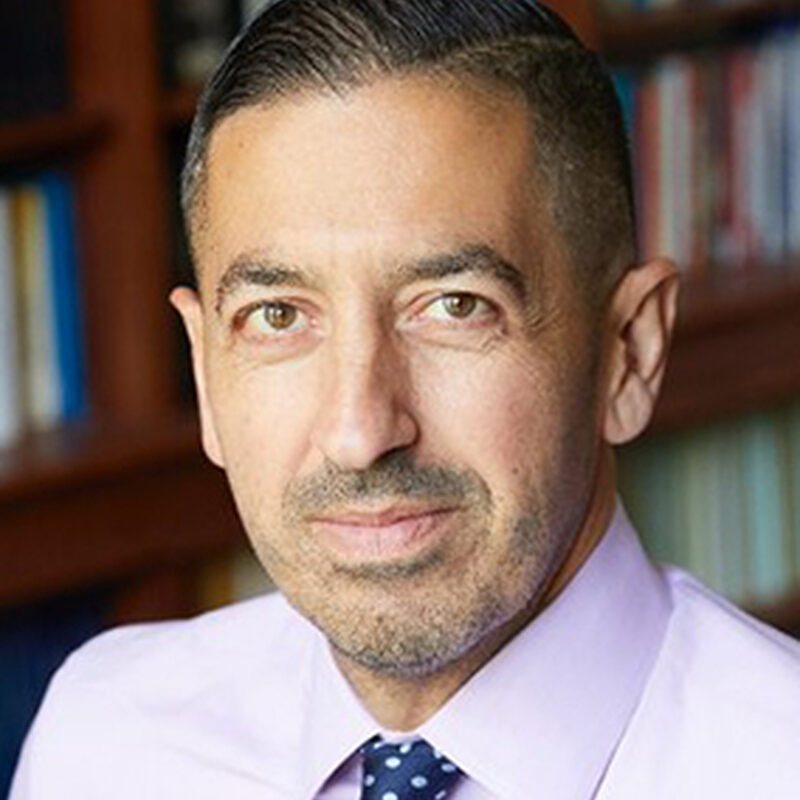
Sanjot, thank you so much for joining us today. We appreciate your time, truly. I have several questions for you, so let’s get started.
Thank you.
In your twenty twenty TEDMED talk, you discussed how love is necessary for health because it helps us see beyond ourselves and put the good of others first. And in your recent novel, The Contagion Next Time, you describe several factors other than medical care necessary to maintain health. Sandra, what are those structural factors that help shape health and disease?
As time passes, we understand more and more that health is much more about the world around us than it is about medicine. So health is made by the conditions in which you work. It is made by the conditions of your home, whether you live in a safe environment. It is determined by whether you had the education to put you in a path where you can actually have material comfort.
It is made by whether or not the air you breathe is polluted. It is made by whether the food you eat is food that is nutritious or whether it’s calorie dense and nutrient poor. All of these are forces in the world around us that we do not typically think of as forces that generate health. We tend to think of doctors as generating health.
And the argument I’ve made historically, I’ve made in the TEDMED talk and I’ve made in my book is doctors do matter. Doctors are important for health, but they are important to restore us to health if we’re already sick. In order to keep ourselves healthy, which is what we all would like to be, we fundamentally want to live in environments that generate health.
When you look at everything that has happened since the beginning of the COVID nineteen pandemic, How would you characterize the way, COVID nineteen exposed these structural vulnerabilities?
The COVID moment has been a real moment of, I think, eye opening for many people about the importance of the world around us for generating health. So in COVID, we recognized, for example, that certain groups were more likely to get COVID and die from COVID than other groups. At a very simple level, who are those groups? Well, warehouse workers, people who worked in retail, people who worked in transportation had a much higher rate of getting COVID than did other groups.
Now why is that? We all could see immediately why that is. It’s because they were exposed to the virus that while many of us were able to work from home, well, you can really work from home if your job is to deliver packages. You can really work from home if your job is to drive a bus.
You can really work from home if your job is to is to be staffing the grocery store. And those conditions resulted in people getting COVID more and dying from COVID more. And I think COVID was instructive to many people because you you see that and you realize, Actually, doctors have nothing to do with that. Doctors have nothing to do with the fact that if you are driving a truck in the middle of a pandemic for which we have no vaccines as early on in COVID, you are more likely to get the pandemic than if you are able to just sit at home and isolate yourself.
So it became very clear that these conditions, conditions of employment, conditions where people live, whether people live in houses which were densely packed with others who were coming in and out, or whether they will able to isolate in their own rooms, those conditions resulted in people having a different risk of getting COVID. And I think that made it obvious to large segments of the population that health was determined much more than by doctors themselves or even by vaccines themselves, but also by the world around us.
Yeah. I couldn’t agree more with you, Sandro. You know, in our space, in community health and home health and hospice, they were folks who worked from the computer and were able to continue to earn their income and work at home. And then there were the essential nurses, essential workers rather, nurses and therapists and aids who had to continue, and do their job out in the field, and had an increased exposure. So I I surely agree with that.
Yeah. And and, you know, we tend to think that, that many people work from home. But in fact, it was only minority of Americans who worked who were able to work from home, but thirty five percent of Americans were able to work from home. Most working Americans were not able to work from home, and, and that created this enormous inequality in terms of risk of getting COVID.
Yeah. It’s an interesting statistic.
So what do you think we’re learning about the vulnerabilities of the health system in the United States?
Well, let me start with the positive. We we learned that the health system did very well during COVID. Now what do I mean by that? People who went to hospital did well during COVID.
Our outcomes, our metrics for people who actually got to to hospital were better than all other countries. The challenge was not people who got sick and got to hospital and being looked after. It’s keeping people from getting sick to begin with. The challenge was that we had a higher rate of getting COVID, and we had a higher rate of people getting severe COVID and getting to hospital too late than did other countries.
So I think what we learned was that our curative system, our system of making you better if you’re already sick, works well. And it works well because we spend so much money on it. So it’s not unreasonable that it works well. But our system of keeping it from being sick to begin with is really poor and, in fact, largely nonexistent.
When you envision our next step toward a healthier society, what is that step, Sandro?
I think we need to start thinking about health much more holistically than we ever have in the past. You know, my TEDMED talk, I talked about love. And I talked about love as a, really, a metaphoric form of love, as a love that that says we are compassionate to one another. We love one another.
And as a result, we care about creating an environment where we are all healthy, that I care about you and you care about me. And when you start thinking that way, you realize that I actually I care about you having the adequate employment conditions. I care about you having a clean air to to, breathe. I care about the fact that you live in a safe neighborhood.
Now when I care about that, that means that I actually care about public policy that encourages those things. That means I incur that I care about public policy that creates safe neighborhoods, not just for me, but also for you. That’s the love I talked about in my TEDMED talk. And I think that’s the next step in thinking about health.
It’s thinking about health as a motivation for me to care about the conditions that keep you healthy and for you to care about the conditions that keep me healthy. And the argument I made is that if you care about me, I care about you. We care about one another. We are going to invest in conditions that generate health for all.
And then to build on that, what actions can we take as a community on a local level to move toward a healthier future?
Yeah. The there there is ultimately, all health starts locally. And, and I think there are within our local, like, small environments. If you take my love idea metaphorically extended, you’re ultimately starting off with your family, then you move into your neighborhood, then you move into your community, then you’re moving to your municipality, then you move into your state, then move into your country, then move into the world. And there are all sorts of decisions that are made about our local environments that where the decision point is, do we invest in, do we privilege, do we the few, or do we invest in and prioritize the many? And the more we can think of the many, the more we’re going to create a universe that generates health and healthier people in that universe.
That’s such a great point. Thank you. And when you think about creating a healthier future, what do you think about the way COVID nineteen has affected the physical and emotional health of children?
So one of the, I think, saddest consequences of COVID nineteen is going to be the generational impact it’s going to have. We know that there has been a tremendous increase in, mental health disorders, particularly mood what are called mood anxiety disorders, things like depression and anxiety, post traumatic stress. And we know that those disorders are lasting for a long time. And, the children are bearing the brunt of that.
When you look at different ages and you look at the increase in mood anxiety disorders, they are increasing more for people under the age of twenty four. We see that, for example, my, in my day job. I’m, dean of a school public health, which means I’m on a college campus all the time. And we see that in college campuses.
You see it in high schools. You see it in primary schools. And when young people have depression or they have anxiety, they now have had it once, which means that they are going to have it be at greater risk of it again in their lifetime. So we’ve created a generation where the risk of these mental health problems is going to stay high and stay with them all their lives.
So I think we have turned a corner where we need to recognize that mental well-being is an inescapable part of our health and of our well-being, and we as a society need to invest in approaches to protect mental health and to make sure that people can still flourish despite this greater risk for mental health problems throughout their lifetime. Mhmm.
Great point.
Sanjoy, I I would like to ask, though, I mean, what are your thoughts on, you know, the social isolation and what of this disengagement, you know, that really was it manifested itself through children and and the elderly, you know, specifically. Yeah. But the social isolation, I think, had such a you know, ushered in a myriad of, mental health issues as well. And, unfolding that now is quite a challenge.
No. I couldn’t agree more. I think social isolation has been a real problem, and I actually think that we as a society underestimated the cost of social isolation. And, you know, I mean, you see it in very tangible ways. For example, the increase in death from drug overdose, which a lot, you know, a lot of it comes directly from people being more social isolated and using riskier drugs.
So the, but I think, fundamentally, things like the the general anomie that people feel and the the sort of lack of engagement, lack of purpose, lack of wishing to reintegrate, these are all costs of social isolation. And, you know, so I think there are obviously decisions that had to be made about, isolating people in order to reduce risk of transmission of the virus, but we have learned there’s a real high cost to that. And I think in future, we’ll be making the, trade off decisions informed by that, which which when this happened, I think there was a general sense of, well, you know, there’s no what’s the harm of if we keep away from each other for a bit? And I think we’ve learned there’s a lot of harm by keeping away from each other.
Why do you have hope that we’ve become motivated to take action to make changes that will foster a healthier world?
Well, I prefer hope because I prefer to the alternative.
But at a more pragmatic level, I, I am hopeful because we are having this conversation.
I am hopeful because the idea that different groups have different vulnerability to poor health because of their education, their income, their environment that they live in, neighborhood violence, is now something that we discuss publicly all the time. And it did not used to be like that. So I feel like we’ve had a awakening as a world to these realities around us, and that awakening is going to serve us well. It’s gonna serve us well because we’re going to realize that if we do not invest in the full totality of makes us healthy, our health is never going to be as good as it can be.
Be. You know, I I choose optimism and say that, yes. We will, we we will get find our way back to, to a, to a new and better normal. But I do think that there is a generation of people who have been affected who remain at risk and will remain at risk for decades to come.
I do think that’s the case.
I think you’ve given us such great points in learning the right lessons for the next crisis. Actually, I I did read that, that line in your book, and I thought it was, quite profound.
And, you know, I wanna thank you so much for your time today. We really, really appreciate it, and, I appreciate this conversation. Thank you.
Thank you for talking. I really enjoyed it.